
How I work · Osteopathy
Myofascial induction
A gentle approach to working with the fascia.
How I work · Osteopathy
A gentle approach to working with the fascia.
A gentle manual approach focusing on the fascia, movement and tensions within the body.
Some people come in with a stiff neck, a stiff back or a shoulder that doesn’t quite move comfortably. Others continue to experience tightness following a fall, an injury or surgery.
In my practice, I use myofascial induction to assess and address tissue tension. It is a particularly gentle manual technique that I combine with structural, visceral and sacrocranial osteopathy. The pressure, touch and duration of treatment are tailored to each individual.
Fascia is a connective tissue that extends throughout the body. It envelops and connects muscles, joints, nerves, blood vessels and the tissues surrounding the internal organs. It also plays a role in the transmission of forces and in movement.
That’s why I take it into account when assessing a stiff neck, lower back discomfort, tension in the abdomen or a scar that pulls when you move. I’m interested in the condition of the tissues in the area, which movements are restricted and how they respond to touch.
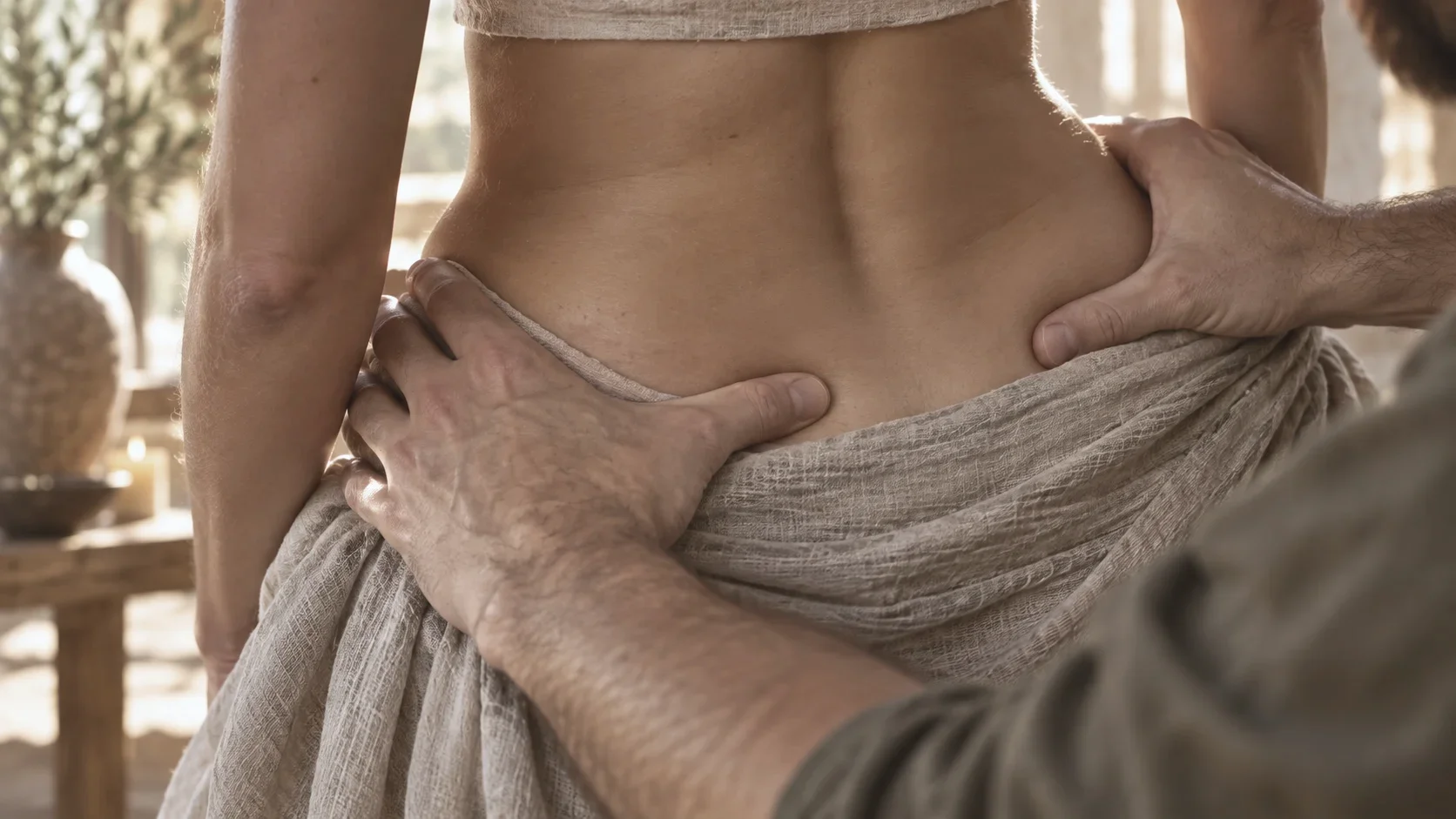
Myofascial induction is a manual approach in which I apply touch, gentle movements and sustained pressure to the tissues. Through palpation, I explore sensitive areas, areas of tension and differences in mobility. I then adjust the position of my hands, the direction of the touch and the duration of the technique.
I don’t aim to apply too much pressure. My approach is gradual and respectful of how you’re feeling. If a technique feels uncomfortable, I’ll adjust it.
The aim is to help relieve certain aches and pains and restore comfort and mobility in the activities you’re finding difficult.
In some cases, we work directly on the area where you feel the discomfort. In others, the assessment identifies nearby areas that are also involved in the movement.
First, we’ll discuss what’s troubling you, how it started and which activities you’re no longer able to do as normal. I’ll then observe your movements and examine your tissues with my hands.
During the session, I use gentle, sustained pressure. Some techniques are carried out over clothing, whilst others require direct contact with the skin. I do not use any equipment for this technique. I’ll explain what we’re working on and ask you how the pressure feels.
Fascia forms part of my comprehensive assessment. Depending on the individual case, I combine myofascial induction with structural, visceral or sacrocranial techniques. I do not follow the same sequence for every patient.
Through myofascial work, I aim to reduce stiffness, relieve discomfort caused by tissue tension and restore movements that have become uncomfortable. Myofascial release has been shown to have beneficial effects on pain and function in studies on certain musculoskeletal conditions, including chronic lower back pain.
During and after the session, some people notice less stiffness, greater ease of movement or a feeling of relaxation. Others need to see how they feel over the following days, when walking, working or resuming their usual activities.
The aim is to assess these actual changes and decide which areas require ongoing treatment.
Follow-up is also part of my approach. Particularly when working on the visceral region, I usually leave 10 to 15 days between sessions, although in some cases we wait up to three weeks.
This time allows me to understand how your symptoms, mobility, rest and bodily sensations evolve in your day-to-day life. At your next appointment, we’ll review any changes and decide whether to continue, adjust the techniques or space out the sessions a little more.
This timeframe is simply my usual way of organising follow-up appointments; it is not the number of days required for all tissues to recover.
Myofascial induction forms part of various aspects of my work. I incorporate it when treating the muscles and joints, the abdomen and diaphragm, or the cranio-cervical areas, depending on the reason for the consultation.
You don’t need to ask for a specific technique. Just tell me how you’re feeling, and the assessment will help us decide what to focus on.
Fascia is also part of your movement.