
Service
Cranial osteopathy
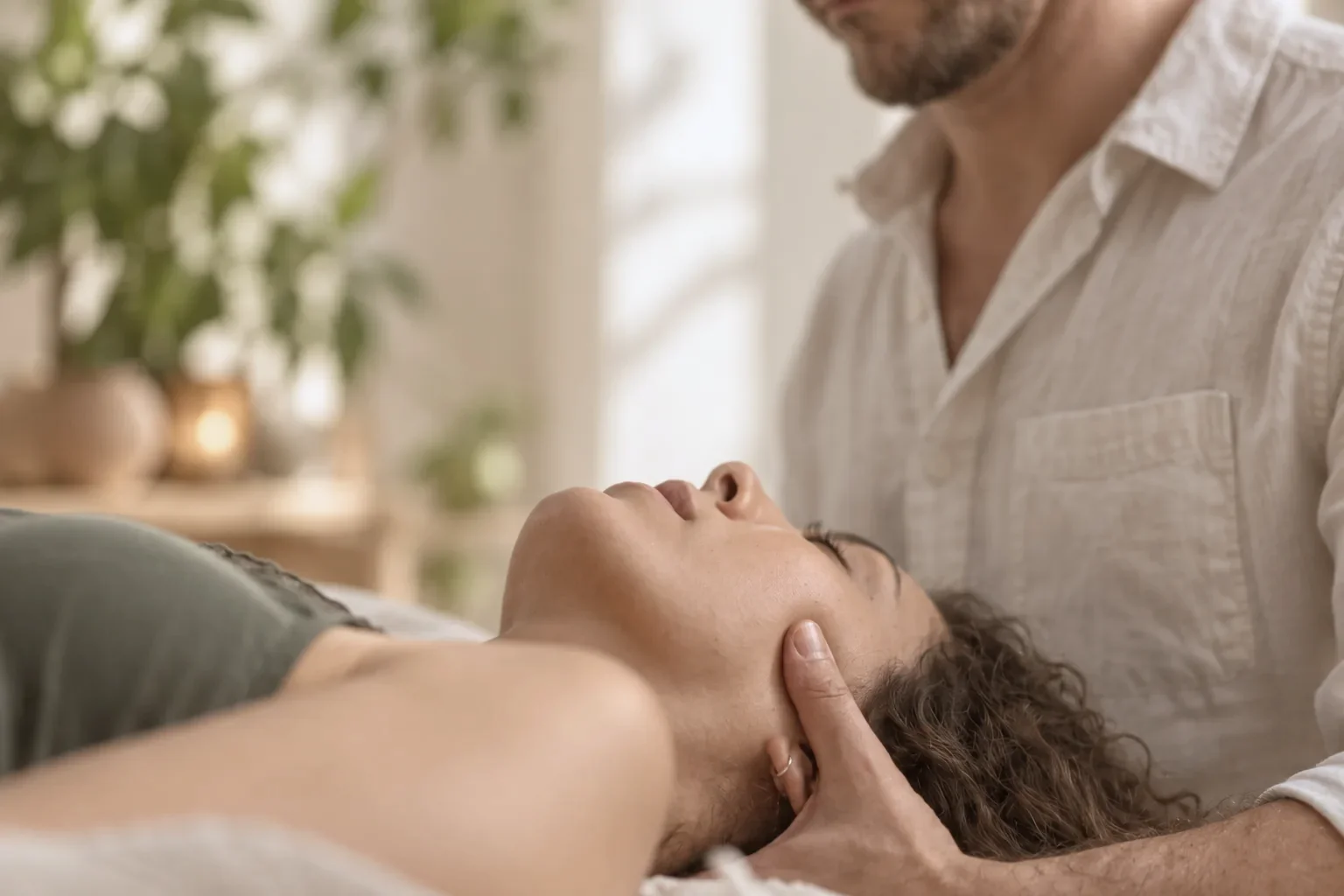
Manual therapy using gentle touch.
Some people come to the practice with a heavy head, tense temples or a clenched jaw.
Others have been experiencing stiffness in the nape of the neck, discomfort in the upper cervical spine or headaches accompanied by muscle tension for some time.
Sometimes everything seems to be concentrated in one area. At other times, through discussion and examination, we find several areas that need to be assessed together.
Cranial and sacrocranial work plays a significant role in my approach to osteopathy. I use a particularly gentle manual touch, incorporating an assessment of the cervical spine, jaw, fascia and other structures where appropriate.
Palpation and what you feel during the session help us decide how to proceed.
What I assess in the cranial region
During the assessment, I focus on the muscles of the jaw and temples, the suboccipital region, the cervical spine and the surrounding soft tissues.
I observe how you move your neck, how you open your mouth, which areas are tender and how they respond to touch.
I’m also interested in what you tell me: when the pain occurs, what happens when you chew, how you rest and which activities are limiting you.
With all this information, we begin to understand which areas may be contributing to your discomfort and which ones we should focus on.
Skull, neck and jaw
The head, neck and jaw are closely linked anatomically, muscularly and neurologically.
That is why some people who clench their teeth also experience tension in their temples, neck discomfort or tenderness at the nape of the neck. Others suffer from headaches accompanied by muscle stiffness.
The fact that these symptoms occur together does not necessarily mean that they have the same cause.
During the assessment, we explore any interrelationships that may be present in your case and take into account when a medical or dental assessment is required.
Sacrocranial work in my practice
The sacrocranial approach forms part of my practice, taken from a manual and holistic perspective.
I combine this with an examination of the spine, the sacrum, the fascia and breathing when I find reasons to assess these areas.
Fascia is a connective tissue that envelops and connects different structures within the body. Its anatomical continuity forms part of my approach to integrating fascial work into different areas of the body.
In my practice, I use gentle, sustained pressure, adapting the pressure and duration of each technique to your response.
This approach does not imply that we can realign the bones of the skull or diagnose illnesses based on supposed cranial rhythms.
Sacrocranial work is a tool I use as part of a broader assessment, without attributing to it any diagnostic or therapeutic capabilities that have not been proven.
A particularly gentle touch
One of the hallmarks of my work is the gentleness of my touch.
In my cranial approach, I mainly use subtle techniques, applying very little pressure and paying constant attention to how the tissues respond and how you are feeling.
I can combine treatment of the temporal region, jaw muscles, nape of the neck, cervical spine and fascia. If the assessment warrants it, we also incorporate the ribcage, breathing or other areas.
We do not follow a set sequence, nor do we need to treat every area in every session.
The intensity and techniques are tailored to you.
Gentle work on the tissues is also an integral part of my fascial approach. Find out about myofascial induction →
What we’ll be looking at together
During treatment, my hands allow me to explore the tissues, their sensitivity to touch and the changes I perceive.
You contribute something just as important: what you’re feeling.
You may notice that you feel more comfortable, that you can move your neck differently, or that the tension in your jaw feels different. It is also possible that a particular discomfort remains the same or that you find a certain technique uncomfortable.
I’d like to hear more about it.
Sharing these sensations helps us to adjust our approach and assess your response. I’ll also explain what we’re working on and why, so that you can better understand how your body responds and play an active part in the process.
Evidence and its limitations
It is important to distinguish between manual work on muscles, joints and soft tissues and the specific claims that have traditionally been made about craniosacral therapy.
That is why I do not present it as a specific treatment for these conditions, nor as an alternative to medical care.
At Ekonatura, I use cranial work as part of a personalised manual approach, tailored to your needs and how you respond during the session.
I’ll explain when it’s advisable to consult another professional.
What you might notice afterwards
Responses to treatment vary from person to person.
You may notice changes in how comfortable you feel, in your muscle tension or in certain movements during the session or in the days that follow, whilst resting, working or resuming your usual activities.
It is also possible that you may not notice any changes.
I’d be interested to hear how you’ve responded to the treatment, what symptoms remain and whether you’ve been able to resume any activities that were previously uncomfortable for you.
This information helps us to assess your progress and decide how to proceed.
The aim
The aim is to assess discomfort in the cranial, cervical and mandibular regions, understand which structures may be involved, and work manually on the areas we have decided to treat.
We aim to improve your comfort and mobility when these are restricted, and to reduce muscle tension wherever possible.
My approach combines palpation, gentle touch and a shared focus on what we observe.
Sometimes, the gentlest touch is the one that best suits your needs.
Sources and further reading
To find out more
References that expand on the points discussed.
View sources
- ICHD-3. Cervicogenic headache · View source
- ICHD-3. Headache attributed to temporomandibular disorder · View source
- NIDCR. Temporomandibular Disorders · View source